Tuesday, 14 April 2020

The eyes have it


Computer vision: The Summer Vision Project


Why have humans found it so hard to make it possible for computers and robots to see?  Most versions of the story of computer vision begins at MIT in July 1966. There, Seymour Papert set a summer project to ten of his his students in the MIT Artificial Intelligence group. Completely underestimating the difficulties involved, Papert described it as:–
“… an attempt to use our summer workers effectively in the construction of a significant part of a visual system.” 
He expected them to have come up with a simple form of computer vision by the end of August, by which time the computer would be able to identify objects in image, such as:
“… complex surfaces and backgrounds, e.g. cigarette packs with writing and bands of different  colour, or a cylindrical battery, then to extend the class of objects to objects like tools, cups, etc” .[1]
As we now know, this was not accomplished by August 1966. In fact, work on computer vision continues to this day, as we discover just how complicated the process of vision really is.  The early AI scientists simply did not understand that, however much they knew about the mechanisms of vision, they were completely naïve about the process.  *

I continue to find it extremely helpful to explore the differences between how we teach computers to see, and how we as humans learn to see. Very often these differences illustrate profound differences between machine and human intelligences.

So how do we see?

Recently I typed “How do we see?” into my browser. Top of the list of recommended websites was the American website of The National Eye Institute.

This is what it said,
“All the different parts of your eyes work together to help you see. First, light passes through the cornea (the clear front layer of the eye). The cornea is shaped like a dome and bends light to help the eye focus. Some of this light enters the eye through an opening called the pupil (PYOO-pul). The iris (the colored part of the eye) controls how much light the pupil lets in. Next, light passes through the lens (a clear inner part of the eye). The lens works together with the cornea to focus light correctly on the retina. When light hits the retina (a light-sensitive layer of tissue at the back of the eye), special cells called photoreceptors turn the light into electrical signals.
“These electrical signals travel from the retina through the optic nerve to the brain. Then the brain turns the signals into the images you see.” **   [2] 
In addition to this text, there was a diagram. It was just like the ones I had seen and learnt to copy in my school days. Any computer today could learn how to copy this diagram. Even I as a silly secondary school pupil could do it.
The human eye
But what did the diagram teach me?  It taught me that if I learnt  to reproduce it accurately, my teachers and examiners would apparently believe that I understood how we see *** . But of course that was not the case at all.   The diagram glossed over the very bit I was interested in then, and that I am still interested in today. When the description ends with: “Then the brain turns the signals into the images you see”, my response has always been, “Yes, but how does my brain turn these signals into images?”

As a child I tried to imagine whether deep within my brain there could be another, smaller, eye that looked at the data sent back there by my real eye. But how did the smaller eye see? Did it send the data to another, still smaller eye behind it? and so on ad infinitum?


Today I know that in reality the description and the diagram show only how the eye collects a certain kind of data from outside. It says nothing, absolutely nothing, about how we see, how we make sense of the data.

No, that infinite recursion wasn't going to work as an explanation. And since school and College failed to came up with a better explanations, I have spent far too many hours thinking about this question: how do we see?

The evolution of the eye

Light and Dark

I began by studying how the eye evolved in nature, studying how it became more and better refined as a sense organ, in the hope that I might find clues about the evolution of the process of seeing.

So let us start at the start:


Euglena are primitive single cel organisms that lives in water. They are so primitive that biologists place them somewhere somewhere between animal and vegetable. Like plants, they makes their own food by photosynthesis using light. You will see from the picture above that the organism has a red spot. This is a light-sensitive protein that biologists call an eyespot, which detects if light is falling on it or not. The Euglena use this basic information to change their position to face the light.


This, I would argue, has nothing to do with seeing. It is simply collecting the most basic data from the world in which the Euglena live: formless light or dark.


The movement of shadows


A step up from Euglena are Planaria. These freshwater flatworms don’t have eyespots: instead they have two cup-shaped indentations on their bodies, lined with pigmented light-sensitive cells. Where the red eyespot on Euglena can only detect whether there is light or not, the Planaria's cup-shaped indentations give the creature rather more information. Planaria can not only tell if it is light or dark. If light is coming in at an angle, it will fall on the cells on one side of each indentation, rather than the cells on the other side. This means that the Planaria can tell the direction of the light source. If a moving shadow interrupts the light, the opposite will happen. Light will be blocked from falling on cells on one side of each indentation before being blocked from cells on the other side. So the planaria is not only sensitive to the presence of light, not only sensitive to the direction the light is coming from, but most significantly, they  can also tell the direction of travel of a shadow – a possible predator – that interrupts the light.

Planaria do not see images. But does the fact that Planaria are aware of movement in the world around them mean they can see?   


Sight as a sensation


Suppose a creature had the ability to form an image in the same way that a pinhole camera does, with a much deeper depression for capturing light, and a pinhole to provide some focus. With this kind of lens-less proto-eye, the organism would be able to distinguish some features of its surroundings. The sea snail called Nautilus has just this kind of eye. But in fact the image that is formed is very faint and lacks all detail.

True, these dim unfocussed patterns on the retina give the Nautilus a little more information than the movements of shadows across the cup-shaped indentations of Planaria. But in themselves, I would argue that they barely constitute ‘seeing’.

I would argue that the significant difference between how Planaria and Nautilus respond to visual information coming from the world around them, is that as well having two light-sensitive pinholes, Nautilus comes equipped with a very sophisticated sense of smell, sense of touch and additionally both a short-term and simple long-term memory. Planaria have only a crude sense of touch and some sensitivity to certain chemicals. It is possible that they have a very basic memory of locations. ****.

As the Nautilus forages, the patterns of light and shade that move across the simple retina will inevitably coincide with smells and the sensations from its antennae. (Some of the antennae are used for smell, some for touch only). 

Nautilus will experience patterns of coincidence occur over time. (The Nautilus can live for 20 years). Let us imagine a young Nautilus who finds that whenever this dim image forms, it smells this odour and feels this texture at the end of its tentacles. And when that smell is weaker, and that part of the image is smaller, the Nautilus's tentacles can no longer touch that thing out there. The young Nautilus might guess that the thing in the image is further away. The young Nautilus begins to be able to make guesses about objects in the world around it.  

When the mature Nautilus ‘sees’ something which is out of reach, the data going down the optic nerve are not perceptions. The guesses are not seeing.

The seeing is based on our Nautilus's experience of what is likely to be out there, given the regularity with which the sensations across its senses match its past experience.

I begin to understand that it is our experience of coinciding and consistency  across senses that is the beginning of perception as sight.

I will try to tease this out in the next entry.


* It reminds me of the old man in the story who said, “I can give you the explanation, but I cannot give you the understanding.’

** The National Eye Institute article ends rather poetically by saying, “Your eyes also need tears to work correctly”, adding a mysteriously romantic world view to its very limited explanation.

*** When I learnt to reproduce the diagram without any understanding, somehow it was I who felt a fraud, when of course – as so often in secondary education –  it was the teachers who were fraudulently passing off a physical description as an explanation of something far more complex.

**** A recent paper describes a rather goulish experiment which claims to show that Planaria can “exhibit environmental familiarization, and that this memory persists for at least 14 days - long enough for the brain to regenerate. We further show that trained, decapitated planarians exhibit evidence of memory retrieval in a savings paradigm after regenerating a new head.” [3]


[1]   Papert, S. The Summer Vision Project  Artificial Intelligence Group , Vision memo No. 100 July 7 1966  at http://people.csail.mit.edu/brooks/idocs/AIM-100.pdf  accessed 14 April 2020.
[2]   National Eye Institute. How the Eyes Work.16 July 2019. https://www.nei.nih.gov/learn-about-eye-health/healthy-vision/how-eyes-work (accessed April 11, 2020)
[3]   Shomrat T, Levin M (October 2013). "An automated training paradigm reveals long-term memory in planarians and its persistence through head regeneration". The Journal of Experimental Biology. 216 (Pt 20): 3799–810. 

Wednesday, 1 April 2020

Making and Faking


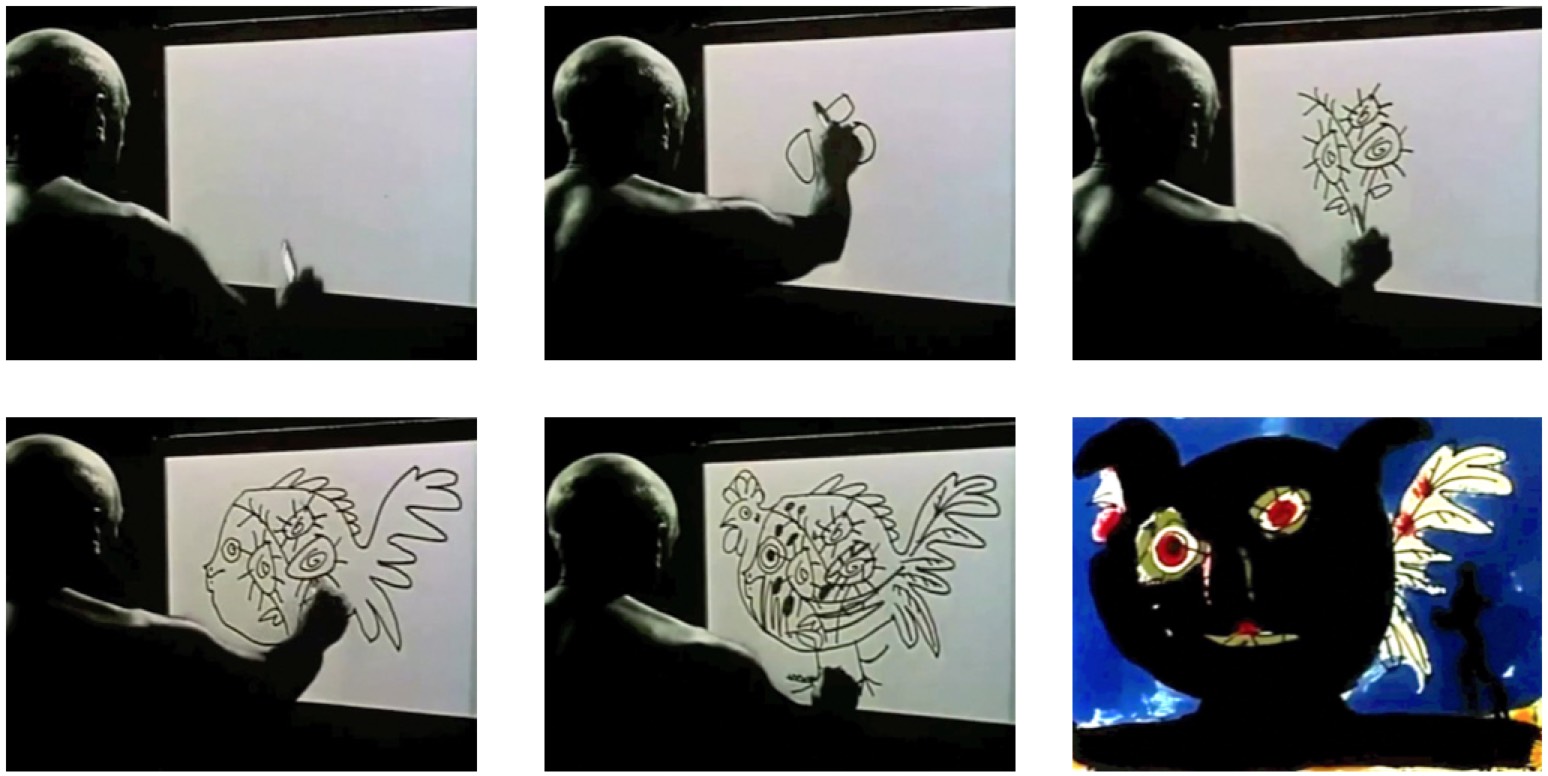
Picasso goes on a journey:  From Le mystère Picasso (1956) by George Clouzot


Picasso at work: he draws three circles. He adds spikey lines and they become a cactus. A looping line around the cactus turns it into a fish with an extravagant tail. Another swirl and the fish becomes a comical chicken. “I’ll add some colour,” he says, and with a few brushstrokes the cactus/fish/chicken has turned into a smiling mask with staring eyes. What a journey of discovery! [1]

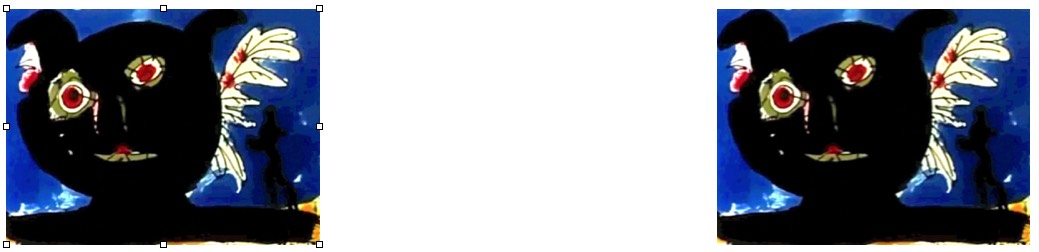
A forger makes a brilliant copy of Picasso’s picture. We subject it to photographic analysis and see that to all extents and purposes the two images are visually identical. But do they differ in other ways?

Certainly one is worth more than the other; perhaps one is located in Paris and the other in London. But that’s not very interesting. More interesting is that Picasso had to make his picture before the forger could begin. 

Two apparently visually identical images of a head
The original Picasso picture and a visually identical fake of the same image
Then consider this: when Picasso was starting his picture, he knew how to begin, but he didn’t – and couldn’t – know how the journey would end.

On the other hand, when the forger started work, all he had to go on was the end point. His particular skill lay in knowing the end point really well and then working out how to get there. Let’s call this skill ‘faking’, and let’s call the painter’s skill – that of knowing the start point, and being able to reach out from there, ‘making’.

What’s the point of making this distinction? Imagine that you want a new kitchen. If you’re sensible, you’ll make sure that the design process is a making and the better you know your start point, the better your design will be. But when you hand the designs over to the carpenters, you will want them to understand exactly how they should end up and you want them to know how to get there: you want them to be, in our new terminology,  fakers.


You can see what could go wrong if you confuse these two ways of working. See also The problem with problems, elsewhere in this blog.


[1]    Le Mystère Picasso (1955) dir. Henri-Georges Clouzot Director of Photographie Claude Renoir, produced by Filmsonor, Paris, Distributed by Les Acacias, Paris

Thursday, 26 March 2020

From evidence-base policy to irrational dogma

The loss of control

Evidence-Based Medicine begat Evidence-Based Management which begat New Public Management which begat Performance Management, all in a drive to make state-run services covering health, policing and education more efficient and more business-like.


In each case the service in question were treated as if they were closed systems, where every problem had a solution waiting to be found, and every action had a predictable reaction.

In each case, the first step was to carry out baseline measurements against which governments could measure progress. The idea was that by taking sample measurements – ideally representative samples – you could get a reading of the condition of the entire enterprise, which would inform decision-making.

We will never know what the consequences would have been had the measuring had been done with some objective rigour, and had the choice of what was being measured been its significance rather than how easy it was to get at the numbers, and if the tools for measuring were up to the job. But as we have seen, this was rarely the case.

Even if the measuring had been done rigorously and appropriately, its usefulness to inform decision-making was entirely undermined as soon as the policy makers began to use the measurements as targets. It was at that point that the systems slipped out of control. The incentives and threats served to encourage individuals and management to game the numbers.

So powerful have the incentives been to achieve centrally determined targets, and so powerful have the threats been for those who risk failing to meet their targets, that for many – the administrators and the administrated alike – meeting targets has become the be-all and end-all of what they do on a daily basis, surpassing in importance not just the nuanced aspects of the job they have been trained to do and which many of them entered as a vocation, but the very raison d'être of the profession.

New Public management pushes people to focus on the only the aspects of their work that can be numerically quantified and to ignore what years of experience and common sense have taught them has significance.

It is hard to conceive of changes to public administration which would have made all this worthwhile. In fact, all the evidence suggests that the sacrifice of careers, the enormous costs, the lives shortened or damaged by stress, to say nothing of the thousands of premature deaths, have all been in vain. The system of Performance Management which set out to replace an inefficient and irrational system with one that was both rational and efficient has failed to meet its own targets.


The NHS

The last major report on the state of the National Health Service before the introduction of Performance Management was the 1979 Royal Commission. The Chair, Sir Alexander Merrison summarised the findings in a retrospective essay in 1984:

“The report gave the NHS a reasonably clean bill of health … As to value for money and patient satisfaction the NHS was doing well.” [1]

As we have seen, by 2013, after nearly two decades of Performance Management, Foundation Trusts were so focused on hitting financial and waiting-time targets that they “forgot why they were there” and the Service’s supervisory organisations proved themselves to be impotent.

Spending is barely under control. In a well researched article in the Spectator in 2002, George Monbiot wrote that the Private Finance Initiative has led to a situation where every £200 million spent on privately financed hospitals will result in the NHS losing 1,000 doctors and nurses and where the first PFI hospitals contain some 28% fewer beds than the ones they replaced [2]. In 2007 Jean School of the Manchester Business School reported that funding hospitals from the private rather than public sector cost the NHS almost half a billion pounds more every year, a cost that ‘must reduce access to health care and other public services'. [3]

Patient satisfaction surveys from 1983 showed a steady increase in satisfaction until 2011, then,
The 2018 survey, carried out by the National Centre for Social Research, is seen as a gold standard measure of public attitudes. It finds that, following a sharp drop in 2017, public satisfaction2with the health service fell by a further 3 percentage points in 2018 to 53 per cent, its lowest level in over a decade and 16 percentage points below its historical peak of 70 per cent in 2010. [4]
Performance Management has failed utterly to make the Health Service more efficient and has resulted in increased patient satisfaction

The Police

Has the Police Force become more efficient since the introduction of Performance Management? How should we measure its efficiency? In the Statement of Common Purpose published by the Association of Chief Police Officers in 1990, the main function of the police are defined as “to pursue and bring to justice those who break the law” – to solve crime – and “to protect, help and reassure the community” – to prevent crime. [5]

So has the Police force become more efficient at solving crime? We simply do not know. As innumerable reports have shown, the police have gamed the figures on crime detection to the point that they cannot be trusted.

But if we cannot test the efficiency of the police when it comes to solving crimes, we can at least examine their efficiency at preventing them. The best and simplest measure is to compare the number of police employed in any one year with the number of reportedcrimes in the same period. This will produce a figure for the number of crimes per officer. If the police are becoming more efficient, then the number of crimes per officer should be going down.

However between 1981 and 2011, when Performance Management was introduced, the number of crimes per officer increased nearly threefold from 23 to 67 crimes per officer. [6] [7]

Education

Can we tell if education has become more efficient since the introduction of Performance Management? Again, it is a question of measuring inputs and outputs. Measuring the quantity of inputs – the number of teachers and the resources and their deployment is an easy matter. Measuring the output is much harder because it is – or should be – qualitative.

Three scales have been devised to measure learning output internationally. PISA, the Programme for International Student Assessment, is intended to measure scholastic performance on mathematics, science, and reading; TIMSS focuses on knowledge of science and mathematics, and PIRLS, the Progress in International Reading Literacy Study, is an international study of reading achievement in fourth graders.

As assessments of educational attainment, all of them are extraordinarily one-dimensional. They measure only what can easily be tested numerically. And because a country’s position in a PISA league table has become a matter of international prestige, the government focus is on teaching to the test, focusing on literacy only in the areas of maths and science and English language. Creative literacies – visual, musical, and dramatic, as well as physical literacy are ignored in terms of output and are therefore neglected in the curriculum.

If we agree with Jim Callaghan's statement about the purpose of education, that it is to “equip children to the best of their ability for a lively, constructive, place in society, and also to fit them to do a job of work,” then any measure of the effectiveness of an education system will include an assessment of how well it prepares children for their future life.

The neglect of children’s creative literacies is the more surprising then when learn that the creative industries were worth £111.7 billion in 2018 to the UK economy (Department for Culture, Media & Sport 2015) , that the number of jobs in the creative industries has increased by 4% year-on year since 1997 reaching 3.2 million in 2018 a accounting for 1 in every 11 UK jobs, a proportion that is increasing five times faster than the rest of the economy. [8]

To put that into perspective, only the sectors of Hotels and Restaurants, Construction, Business Services, Administrative and Support Services, Education, Transport Storage and Distribution, and Health and Social Care employ more people.

A very significant number of children in education in England and Wales are most likely to find work in the creative industries. Pasi Sahlberg, the Harvard Professor of Education argues that

“Countries that want to be higher on the PISA tables should understand what it truly takes to get there,”
and that, he says, includes
“a balanced curriculum that has equal weight in arts, music, and sports, and academic studies.” [9]
It is clear that if we are to consider the efficiency of the education system, we cannot ignore the quality of the education that the students receive – as the 2013 Department of Education Review of Efficiency in Schools does. Nor can we consider only those aspects that can be measured in numbers, because these are not the only aspects of what education should be doing.

The only source of information about whether or not the full educational outputs have improved or declined since the introduction of Performance Management in education are Ofsted and the teachers themselves. Unsurprisingly, Ofsted said, as cited above, that improvements have been widespread[10]. But as we saw, some two thirds of schools said that the harm caused by Ofsted outweighed the benefits. Most critically the Academies Commission found “considerable evidence” that the current accountability framework “inhibits change and innovation”, so that the regime is failing to achieve its stated goal of improving education.” [11]

Meanwhile, according to the Office of National Statistics, UK public expenditure on education and training doubled in real terms between 1987/88 and 2010/11. [12]


A failure of rationality

To behave rationally is to behave according to the evidence presented to you.

We have seen many examples above, where in critical situations health administrators, senior police officers and – paradoxically – those concerned with education policy and all their watchdogs have failed conspicuously to learn from experience. So today we have a system of public administration that has produced catastrophic results, and which in spite of minor adjustments, continues to fail to meet its own targets, and which has never acknowledged its failure.
The descent from the ideals of evidence-based policy making to this kind of foolishness is, I would argue, the result of a combination of intellectually laziness, opportunism and a refusal to take responsibility when things have gone wrong.

Across public services, honourable people were pressured into falsifying the numbers to the point where no one knew any more what the true situation was, and they felt demeaned by what they were having to do. On top of that, the dedicated health workers, policemen and teachers found themselves torn between two imperatives. The imperative to act like a machine and the imperative to act like a human. The pressure to join this cult of what we might call artificial stupidity was often too strong to resist.
Meanwhile those who ran the system in the name of rationality, who dictated the targets, but who passed all responsibility for attaining them down the line, were returning the systems to levels of inefficiency and irrationality at least as bad as those that their predecessors had revolted against.


From evidence-base policy to irrational dogma

By using baseline measurements as targets and introducing powerful incentives to meet those targets, governments hoped to encourage public services to follow the policies they set, and to force them to achieve ever greater efficiencies. Instead, people began to game the numbers. Targets which were designed to be indicators became ends in themselves – to the extent that dedicated workers were obliged to focus only on the numerically measurable aspects of what they did.
The result was that none of the public services can be shown to have become more efficient. The NHS, which had been doing quite well before, is now in a situation where its spending is almost out of control. Judged by the numbers of police employed against the numbers of crimes reported, the police forces are nearly three times less efficient than they were before the introduction of Performance Management. Measured as a way to equip children for a lively, constructive, place in society, and to fit them to do a job of work, education is now markedly less efficient than it was.

In our schools, pressures to focus on the Performance Indicators have narrowed the curriculum to the point that it neglects the needs of many children, and some two thirds of schools have said that the harm caused by Ofsted outweighed the benefits. Meanwhile spending on education and training has doubled in real terms.

Neither has Performance Management produced more rationality in decision-making. The numbers which provide evidence for performance indicators have been falsified to the extent that as even the Office of National Statistic admits, none can be trusted. When incontrovertible evidence has emerged that policies are failing, decision makers have shown an almost total inability and unwillingness to face reality and learn from their mistakes. We have gone from evidence-based policy to policy-based evidence, from evidence-based policy to irrational dogma.


[1]   Merrison, A. (1979). The Royal Commission in retrospect. In G. Teeling Smith (Ed.), A new NHS Act for 1996?London: Office of Health Economics.
[2]   Monbiot, G. (2002, March 10). Private Affluence, Public Rip-Off. The Spectator.
[3]   Shaoul, J., Stafford, A., & Stapleton, R. (2008). The cost of using private finance to build finance and operate hospitals. Public Money and Management, 28(2), 101-108.
[4]   Robertson Ruth; Appleby, John; Evans, Harry; Hemmings, Nina (2019)  Public satisfaction with the NHS and social care in 2018 R esults from the British Social Attitudes survey  The Kings Fund, London
[5]   Newburn, T. (2008). Policing since 1945. In T. Newburn (Ed.), Handbook of Policing.Cullompton: Willan
[6]   The Office for National Statistics. Crime in England and Wales, Year Ending December 2012.London: ONS, 2012.
[7]   Dennis, Norman, and George Erdos. The Failure of Britain's Police: London and New York Compared.London: Civitas:Institute for the Study of Civil Society, 2003.
[8]   Creative Industries Council (2019)  Creative industries growth surge continues in https://www.thecreativeindustries.co.uk/uk-creative-overview/facts-and-figures/employment-figures,  accessed March 26 2020
[9]   Sahlberg, Pasi. “The PISA 2012 scores show the failure of 'market based' education reform.” The Guardian, 8 December 2013.
[9]   Department for Culture, Media & Sport (2019) 
[10]   Matthews, Peter, and Pam Sammons. Improvement through inspection: an evaluation of the impact of Ofsted's work.University of London. Institute of Education, Ofsted, 2011.
[11]   Gilbert, Christine, Chris Husbands, and Brett Wigdortz. Unleashing Greatness: Getting the best from an academised system. The Report of the Academies Commission.Report, London: Pearson RSA, 2013, January.
[12]   Office for National Statistics. “UK education spending more than doubled between 1988 and 2011.” www.ons.gov.uk.ONS. 19 May 2011. www.ons.gov.uk/ons/rel/social-trends-rd/social-trends/social-trends-41/social-trends-41---news-release---uk-education-spending-more-than-doubled-between-1988-and-2011.pdf (accessed May 11, 2015).

Tuesday, 31 December 2019

Introduction


What is the blog about? Today we begin to understand what we mean by machine intelligences and artificial intelligence. We can see that they are already beginning to improve human life. I want to suggest that our enthusiasm for the cultures of machine and artificial intelligence risks creating a particular way of thinking and and decision-making that diminishes what it means to be human.

The first post in this blog gives a justification for characterising this way of thinking and decision-making as Artificial Stupidity. The next posts trace its origins and evolution, and will examine how we came to accept it. Later posts will use the testimonies of people involved in education, the health services and policing to explore how the blind application of Artificial Stupidity works to the detriment of society. I hope that this rather methodical approach will suggest ways of structuring partnerships of human intelligence and machine algorithms to work together for the benefit of all.

When I was asked for whom was I writing this blog, my first response was, “For a general audience.” But of course, this answer dodges the question. In reality, we are each of us specialists in our own varied fields. But wherever or however we work in this society, quite reasonably we tend to be asked to account for what we do and to hold others to account.

I am writing this to start a dialogue with that facet of any of us who has ever been asked to account for their work or who has asked others to do so.

You can read the posts in any order, of course. But I'm writing them to flow in a sequence:

New Public Management and Education

Setting targets in the NHS which ignore the fundamental context  in which hospitals and administrators work – the care of health – has catastrophic, lethal consequences. Setting targets for the Police to make them more accountable and rewarding those who hit the targets set and punishing those who fail, inevitably results in people playing the system until no one really knows what the true crime figures are.

In British education today we have a system that combines the worst of both these worlds. Politicians and education policy makers do not ask and cannot say what education is for, and with their rewards and punishments they encourage a gaming of the system which is arguably even more corrupting than the gaming that happens in policing. Worse, credible evidence suggests that this system is damaging the very children’s education it claims to improve. Report after report exposes this and nothing is done.


The background

Prime Minister Jim Callaghan lays a foundation stone of new residential block Biko House at Ruskin College, Oxford
Jim Callaghan lays the foundation stone of new residential block Biko House at Ruskin College, Oxford
It has been nearly 45 years since any serving cabinet minister, let alone Prime Minister, has asked what our children’s education is for.

The last was Jim Callaghan, then prime minister, who in his 1976 speech at Ruskin College Oxford began a debate on education in Britain that lasted for years. He suggested that:
“The goals of our education … are to equip children to the best of their ability for a lively, constructive, place in society, and also to fit them to do a job of work. Not one or the other but both.” [1]
At the time of the speech, the condition of education – at least in state schools –  was monitored by Her Majesty’s Inspectorate (the HMIs). They inspected schools nationally and the Chief Inspector consolidated and summarised the information they gathered for the Secretary of State for Education. In parallel to HMIs, Local Education Authorities sent teams in to schools in their area, inspecting and more especially, advising.

HMI’s were careful to differentiate particular needs of schools during their inspections; schools understood that inspections were an opportunity to have a dialogue aimed at raising standards, and ministers accepted – even when they did not enjoy – the strict independence of HMIs from the whims and vagaries of governments. The result was that HMIs were generally respected by schools, teachers and parents.

That is not to say it was a perfect system. It suffered from inconsistent standards across the country and many people were concerned about the independence of inspectors, of local chief education officers and councillors.

Up until the 1970s in general education, as somewhat earlier in medical education, people largely accepted that the experts – teachers, Local Education Authorities and civil servants – knew best and were working together for society and for the good of children. But as had happened in medical education, and as was happening in the police, the political climate was changing and the old assumptions and authorities were being questioned, not just by the young, but by the new breed of politicians as well.

Professor Terence Kealey,  vice-chancellor of the University of Buckingham, and a former adviser to Baroness Thatcher claimed in 1980 that it was her reforms that led to more transparency and accountability within the sector, while her push to liberalise rules on fees also had an immense impact.
“Before Mrs Thatcher, universities were very similar to public utilities – run for the benefit of staff with government money. … She was determined to introduce a much higher level of accountability for public funding and greater accountability for students as customers”. [2]
Margaret Thatcher had been Edward Heath’s Secretary of State for Education. Peter Wilby of the Guardian writes that it was there that she developed
“an abiding hatred of its culture: of ‘self-righteously socialist’ civil servants,  …  of ‘trendy’ teachers  (and) of local authorities she couldn't control.” 
He goes on to write,
“As an inexperienced and diplomatically inept minister in the early 1970s, Thatcher clashed with what was later called “the education establishment”. It patronised her as an ignorant outsider, blundering into areas that she was intellectually unfitted to understand. Her revenge, taken after she reached Downing Street, transformed education at every level.” [3]
Her revenge culminated in the 1988 Education Reform act, through which she took powers and independence away from the LEAs and schools, and concentrated them in the Secretary of State for Education. He (there was always the assumption that it would be a male) would decide the National Curriculum (teachers had virtually no say in its design or construction), he would decide the ‘programmes of study’ to be taught at each key stage; he would define the attainment targets which children would be expected to have and be assessed on at the end of each key stage. [4]

The aim was to have a centralised system, with schools subject to market forces, competing for customers (it was never clear whether these customers were the children or the parents or both) and depending for their success on centrally published test and exam results. For Head Teachers and their teams, good results would mean greater job security, more money and less interference; poor results could threaten your job, starve the school of funds and mean more frequent inspections.

Again, as with the police, in the name of efficiency and accountability, we see the power to decide policies moving up the chain and the responsibility for successfully carrying out the policies moving down.

It was left to Thatcher’s successor John Major to complete the transformation. When he took over government in 1990, his new Education Secretary Kenneth Clarke removed the inspectorate’s independence as well: saying that the government was going to:
“take the mystery out of education by providing the real choice which flows from … independent inspection” [5].  
Every one of the 24,000 schools in England would be inspected at least once every four years. This was beyond the capabilities of the existing inspectorate which only had 500 officers. But rather than enlarging it, Clarke replaced it with an entirely new organisation, Ofsted, under his direct control. He gave Ofsted just nine months to produce an inspection framework, hire 7,500 new inspectors, train them, set up an infrastructure and hit the ground running by visiting at least 6,000 schools a year.

That they achieved this in such a short timescale was in its limited way a triumph of organisation. But the cost was appalling.

Remember the ostensible reasons the government gave for replacing the old system: Thatcher and then Major claimed that their reforms would give value for money by imposing Performance Management systems, improve the quality of education and, by letting parents choose their children’s school by comparing like with like, create ‘customer choice’ and ‘customer satisfaction’.

What Ofsted did was a parody of business efficiency: The only way they could hit their target was to simplify the inspection process. In the name of efficiency and levelling the playing field, what was being inspected and how, were standardised to a degree that would have been unthinkable before, and for very good reasons. Where earlier, HMI reports had been responsive to the unique context of each school, its history, locale, catchment area and so forth, now each report had to shoehorn the school into one of seven simplistic categories from ‘Excellent’ to ‘Very poor’, and all reports had to have identical section headings.

Once again, in order to make the act of measuring simpler to manage, the subject being measured was distorted. To compare like with like meant standardising the measure. To improve the quality of education by using the same data, meant using the measure as a test, so that in the end it was the system effectively designing the curriculum, in order to make it easier to examine.


What has been the result?

On the one hand, Ofsted’s own reports claim that improvements have been widespread [6]. However, independent surveys tell a different story: in 1999, only 35% of schools said that the benefits of the Ofsted system outweighed the harm they caused [8]. Later in 2008 when teachers were asked if Ofsted had improved their teaching, only 5% said it had. If you compare exam results when Ofsted began, with exam results in 2003, you see a small but significant deterioration except in the very best schools. [9], [10]   

The Academies Commission  finds “considerable evidence” that the current accountability framework “inhibits change and innovation”, so that the regime is failing to achieve its stated goal of improving education.” [11] 


The impact on children


On the ground the situation is much worse. Demos said in 2013 that the “target-driven accountability in the English education system is … toxic to the life chances of children and young people.” [12]

Schools are abandoning the idea that a child’s journey through school should be designed as far as possible to met her or his needs. We have evidence that schools have responded to the pressure of league tables by
“Dissuading students from qualifications that would have value for them as individuals and persuading them instead to take easier qualifications that will contribute to the organisation’s ranking.” [13]   
For example, is not unknown for a school to tell parents to be told that their children could not take Art and Textiles as two subjects for GCSE as they were the same qualification. But the same school would let them take Art and Photography as two separate subjects. * 

When questioned, it turns out that while the children could get two GCSEs for their studies in either case, the school would be credited with two GCSEs only if the children took Art and Photography. Even if the children passed Art and Textiles exams, the school would only be credited with one GCSE  because of the complex and arbitrary rules of  ‘discounting’ that the department of education has deemed necessary [14]. 

In other words, in at least some schools, the design of a child’s education is governed by what will benefit the school, not the child.

We have evidence that schools are narrowing the curriculum because they are

“put under pressure to achieve a particular set of (moving) targets, (so) they can find it hard to hold on to the other things as well” [15] .  
Since the culture of new management came into education, children have far fewer opportunities to become involved in those aspects of creativity and sport that  employers say are going to be essential for their future well-being.

A House of Commons Select Committee reported that they,
“Received substantial evidence that teaching to the test, to an extent which narrows the curriculum and puts sustained learning at risk, is widespread. …test results are pursued at the expense of a rounded education for children. … We believe that true personalised learning is incompatible with a high-stakes single-level test which focuses on academic learning and does not assess a range of other skills which children might possess.” [16]
In 1999 57% of teachers said that changes resulting from Ofsted inspections resulted in the quality of education either deteriorating or not changing at all. 66% said that the educational standards achieved by the pupils had either deteriorated or not changed at all. [17]

And it seems that it is those who most need support who suffer most: The 2011 Demos and Private Equity Foundation report on the relationships between education and employment prospects particularly highlighted the way that the
“Value put on academic performance tended to create situations where those who had the strongest need to develop character skills – to become ‘more resilient, better at self-direction and possessing higher levels of application’ – were least likely to be given opportunities to do so.” [18]  

The impact on teachers

But Performance Management is not just toxic for children. Mary Bousted, the general secretary of the Association of Teachers and Lecturers said at the ATL 2015 annual conference, that the profession had become  “incompatible with normal life … with teachers exhausted, stressed and burnt out”. She went on,
“In 2011, the latest year for which figures are available, just 62% of newly qualified teachers who gained Qualified Teacher Status that year were still in teaching service a year later.” [19]
And the reason she gives is that
“…newly qualified teachers see very early on just what teaching has become and decide that they do not want to be a part of it.”
Ofsted inspections were the main culprit:
“Uncertainty was induced, with teachers experiencing confusion, anxiety, professional inadequacy of the marginalisation of positive emotions. They also suffered an assault on the professional selves, closely associated among primary teachers with their  professional roles.” [20] 
Far too often the inspectors themselves show a contempt for teaching and learning. One example demonstrates this nicely: the Senior Vice President of the Teacher and Lecturers’ Union is herself a practicing teacher. During on Ofsted inspection, she was told that the lesson she had taught was ‘Good’ rather than ‘Outstanding’. When she asked the inspector what she could do to make it ‘Outstanding’, he replied, “That’s for me to know and you to find out” [19].

As one Head said,
“You are made to feel totally incompetent. You are made to feel that everything you’ve done for the last 20 years is absolutely useless. [21]
In 1999, the National Foundation for Educational Research found that  24% of heads and 38% of teachers took time off for health reasons after Ofsted inspections.  Scanlon reports that at least one Head of Department
“simply walked out in the middle of the inspection itself and never came back. In the most extreme cases, heads or teachers were off work for months due to stress-related illness.” [17]
But perhaps just as damaging is the way Performance Management has pushed teachers to adopting corrupt practices in a way that is remarkably similar to the corruption that has been so endemic in the Police.

Cheating at SATs is so widespread, that when teacher after teacher described the methods used in the Guardian in 2002, no one was very surprised. [22]

In 2009, 70 schools had SATS results annulled or changed because of cheating. [23] In 2011, there were 292 reported cases and 370 the following year. But to get a sense of how prevalent the cheating is that does not get picked up, one has to go on to parents’ internet websites, where mother after mother worries about the stories of teachers ‘helping’ their children and agonise over whether or not to object.

In another report in 2013, one school one teacher is quoted as saying,
 “Nobody had bothered to get these kids to complete coursework - just give them a C,” “Then the exam board asked for samples of pupils' work to moderate the marking. The deputy head then asked teachers to ‘help’ the students complete 18 months of coursework in a fraction of the time” [24]
“At present honest teachers have only two choices: either ignore the injustice and continue to be punished for results which are lower than neighbouring schools which cheat, or blow the whistle on friends and colleagues - an extremely difficult thing to do. [25]

The impact on Schools

It is not just teachers who are being corrupted. Whole schools are affected.
“Statistics published in December by the exams regulator, Ofqual, show a 61% rise in the number of schools and colleges found guilty of malpractice last year, with 217 penalty notices issued, one for every 30 schools or colleges in the UK.” [25]
The reasons this happens are quite clear:
“The incentives for schools to push the boundaries to raise results seem very strong, and yet the disincentives, in terms of penalties and publicity, seem weak. …This can penalise schools that have acted properly and then find themselves competing, through league tables, against others that may not have.”[25]
Concerns have also been raised about Ofsted’s judgements on schools with the poorest and most challenging intakes. The old inspectorate took a school’s context into account, for example recognising  ‘schools in very poor areas . . . which could not . . . match the achievements of the higher categories but . . . did splendid social work’.  [26]   But Ofsted was afraid that this ‘might embed low expectations in some schools and let down the most needy, so they scrapped it. The result was ‘a 1995 study which reported that 90% of schools in the two highest social contexts were judged favourably by Ofsted, compared with only 10% in the two lowest social contexts.  [27]


The impact on policymakers

As Mary Boustead said,
“The findings of the (Public Accounts Committee (PAC), February 2015, report on School Oversight and Intervention) are devastating. In essence, our education system is being run on a wing and a prayer – and if something goes badly wrong, the Government relies upon someone being brave enough to speak out. Who knows what else is going on under the radar. … The PAC finds that action to prevent decline or continuing poor performance in schools ‘is rarely achieved.’ ”[19]
The assumption is that the best way to improve standards in education, is to make judgements about the effectiveness of school leaders and teachers,  in terms of specific criteria.  The people who originally designed Ofsted’s methodology said that a school’s performance against these criteria would be an indicator of how the it was doing across the board. This was based on an assumption that the test would act in the same way as statistical sampling, from which you could extrapolate how the rest of the school was doing. But as we know now,  it did not work out that way.

But what is astonishing, particularly in an educational context, is that no one was willing to accept that things were not working out as expected and no one was willing to do the rigorous, scientific, educational process, of understanding in what way it was not performing as expected, and for what reasons, in order to design a better process. In order to learn from experience, as every teacher knows, you have to accept and analyse your mistakes. That is what we ask of children. We should expect it of our teachers and of the education policy makers as well.

Instead we have an arrogant and irrational system that differs from the one it replaced only in that it claims to be rational and evidence based. How false this claim is, was revealed in 2008.

Just before he became Prime Minister, Tony Blair revealed that he and his wife had chosen not to send their sons to the school in their local catchment area, Islington Green, but instead to send them to the more prestigious Oratory School in Knightsbridge. This was in spite of Islington Green School being rather good – if less fashionable than the Oratory School.  The Times Educational Supplement said of Islington Green,
“Ken Riddell’s design and technology department had been described as a centre of excellence in the previous inspection report, and had improved since. It was just one of a number of robust departments, with a mix of experience and new enthusiasm, drawing in not only local families but parents from neighbouring Hackney. Morale was good, GCSE results were respectable: 38 per cent were getting five A*-Cs.” [28]  
There were rumblings in the press about the Blair's decision. It so happened that on the day Blair became Prime Minister in 1997, the school was told that it had failed its week-long Ofsted inspection. The staff were stunned. Ken Riddell told the TES,
“We didn't believe it, because we knew it wasn't true. We thought it was a mistake that would be sorted out.” [idem]
The School was put in Special Measures, and its reputation was ruined.

Eight years later, in 2005, following a request under the Freedom of Information Act, the TES learned that the original inspection had not failed the school at all. But Chris Woodhead, the then Chief Inspector of Ofsted – who had not visited the school –  chose to disagree with his own inspectors’ findings in a way that supported the Blair family’s decision. He sent in another team to back him up. But they too concluded – unanimously – that it was not failing. Woodhead overruled them as well. When questioned later, he said only that the decision had been within his powers. As the School’s headmaster said, the pupils believed for seven years they had been to a rubbish school and that their teachers were incompetent.
“Placing the school in special measures had been catastrophic for staff and pupils. Many colleagues who worked at Islington Green have suffered in their careers because of this unjust decision. However, the greatest victims have been the children of Islington” [29]
“The failure had devastating consequences for the school, which became notorious when pupil violence and behaviour soared out of control. There was a mass exodus of teaching staff, including eight heads of department and deputies, and a slump in GCSE results which dragged it into the bottom 2% of all schools nationally.” [30]
The school stayed in special measures until Woodhead resigned in 2000. The Blair’s children went to the Oratory school and no one needed to ask why their parents had not sent them to school in Islington. **

The regime that had been designed to replace supposedly inconsistent and arbitrary inspections with evidence-informed policy, had started to even more inconsistent and arbitrary inspections leading to policy-based evidence.

Worse, the data Ofsted has been collecting is almost certainly unreliable. The House of Commons Select Committee on Children, Schools and Families in their Third Report of Session 2007–08, said,
“The evidence we have received strongly favours the view that national tests do not serve all of the purposes for which they are, in fact used. The fact that the results of these tests are used for so many purposes, with high-stakes attached to the outcomes, creates tensions in the system leading to undesirable consequences, including distortion of the education experience of many children. In addition, the data derived from the testing system do not necessarily provide an accurate or complete picture of the performance of schools and teachers, yet they are relied upon by the Government, the QCA and Ofsted to make important decisions affecting the education system in general and individual schools, teachers and pupils in particular.” [31]
And the very act of collecting this unreliable data is done at the expense of the education of the very children the testing is intended to benefit. The Committee report continues with a section headed, “The consequences of high-stakes uses of testing”:
“We consider that the measurement of standards across the full curriculum is virtually impossible under the current testing regime.”

New Public Management created a system of accountability in our education system which is “toxic to the life chances of children and young people”, which has demonstrably demoralised teachers and schools, which has in well-documented cases encouraged dishonest practices and yet which had failed to produce any accurate measurement of standards. 

The most astonishing is that in the twelve years since the Select Committee Report was published was published, nothing substantial has changed. The masters of education will not recognise the evidence and refuse to learn.


[Next:  From evidence-base policy to irrational dogma ]


*    Personal communication from a parent and former head teacher
**   It is interesting to note that in 1979 in spite of the fact that Islington Green School was still technically failing, Roger Water sought out their school choir to sing the chorus on the Pink Floyd recording of “Another Brick in the Wall”. The words they sang are as follows:
We don't need no education
We don't need no thought control
No dark sarcasm in the classroom
Teachers leave them kids alone
Hey! Teachers! Leave them kids alone
All in all it's just another brick in the wall
All in all you're just another brick in the wall


[1]   Callaghan, James   A rational debate based on the facts  in Education in England October 18 1976http://www.educationengland.org.uk/documents/speeches/1976ruskin.html  accessed March 23 2015 

[2]   Grove, Jack  Thatcher had ‘immense impact’ on higher education  at https://www.timeshighereducation.com/news/thatcher-had-immense-impact-on-higher-education/2003059.article#node-comments    Times Higher Education   April 8 2013    Accessed 1 December 2019


[3]   Wilby, Peter   Margaret Thatcher's education legacy is still with us  the guardian.com  15 April 2013   http://www.theguardian.com/education/2013/apr/15/margaret-thatcher-education-legacy-gove   accessed 24 March 2015


[4]   Gillard, Derek   Education in England: a brief history  in  educationengland.org.uk  January 2011  at http://www.educationengland.org.uk/history/  accessed 23 March 2015


[5]   Wilcox, B; Gray, J   Inspecting Schools  Open University Press, Buckingham  1996


[6]   Ofsted. (1993-2011). Annual Reports of HMCIs of Schools.Ofsted.


[7]   Matthews, P., & Sammons, P. (2011). Improvement through inspection: an evaluation of the impact of Ofsted's work.University of London. Institute of Education. Ofsted.

[8]   Thomas, G  Standards and school inspection: the rhetoric and the reality in “An Inspector Calls: Ofsted and its effects on schools standards” Cullingford, C (ed) Kogan Page, London 1999 


[9]   Rosenthal, Leslie  “Do school inspections improve school quality?” in  Economics of Education Review  Elsevier Vol 23  2003 pp 143-151


[10]   Shaw, I; Newton, D P; Atkin, M; Darnell, R   Do OFSTED Inspections of Secondary Schools Make a Difference to GCSE Results? in British Educational Research Journal  2003  Wiley-Blackwell Vol 29 issue 1 pp 63-75


[11]   Gilbert, C., Husbands, C., & Wigdortz, B. (2013). Unleashing Greatness: Getting the best from an academised system. The Report of the Academies Commission.London: Pearson RSA.


[12]   Park, J. (2013). Detoxifying School Accountability.London: Demos


[13]   Wolf, A. (2011). Review of Vocational Education: The Wolf report.London: Department of Education

[14 ] 
As an example of the 'complex and arbitrary rules of discounting’ this is the table of
AS Art and Design discount codes published by the Department for Education for Summer 2016 and 2017. No reason is given for the distinction made for art and photography,

From https://qualifications.pearson.com/en/subjects/art-and-design.updates.html?article=%2Fcontent%2Fdemo%2Fen%2Fnews-policy%2Fsubject-updates%2Fart-and-design%2Fart-and-design-discount-codes  accessed 7/12/20


[15]   Park 2013

[16]   House of Commons Children, Schools and Families Committee: Testing and Assessment Third Report.(2008, May 7). Retrieved March 23, 2015 from www.educationengland.org: http://www.educationengland.org.uk/documents/pdfs/2008-testing-and-assessment.pdf


[17]   Scanlon, M. (1999). The Impact of Ofsted Inspections.Slough: National Foundation for Educational Research.


[18]   Birdwell, J., Grist, M., & Margo, J. (2011). The Forgotten Half: A Demos and Private Equity Foundation report on school to work transitions.London: Demos.


[19]   Bousted, M. (2015). Mary Bousted Speech to ATL conference .Retrieved April 1, 2015 from www.ATL.org: https://www.atl.org.uk/policy-and-campaigns/conference/2015/mary-bousted-speech.asp

[20]   Jeffrey, B., & Woods, P. (1996). Feeling deprofessionalised: the social construction of emotions during an OFSTED inspection . Cambridge Journal of Education, 26(3), 325-343.

[21]   Primary teacher, L. n. . The many ways of cheating at SATs. The Guardian, Society Public voices: public values  (2002, June 4

[22]   Greenwood, P. (2002, June 2). Children and teachers testify to the cheating.Retrieved April 1, 2015 from www.theguardian.com: http://www.theguardian.com/education/2002/jun/05/schools.news1

[23]   Swaine, J. (2009, July 28). Pupils disqualified from Sats after teachers cheated.Retrieved April 1, 2015 from www.telegraph.co.uk: http://www.telegraph.co.uk/education/educationnews/5918401/Pupils-disqualified-from-Sats-after-teachers-cheated.html

[24]   Burns, J. (2013, September 4). Schools' tricks to inflate science grades revealed.Retrieved March 26, 2015 from BBC Education : http://www.bbc.co.uk/news/education-23947042

[25]   Mansell, W. (2015, January 13). School whistleblowers call for naming and shaming.Retrieved March 26, 2015 from theguardian.com: http://www.theguardian.com/education/2015/jan/13/school-coursework-cheat-whistleblowers

[26]   Gray, J. (2004). Some frames of reference and traditions of interpretation: some issues in the identification of under-achieving schools. British Journal of Educational Studies, 52(3), 293-309.

[27] Matthews, P., & Smith, G. (1995). Ofsted: inspecting schools and improvement through inspection, Cambridge Journal of Education. Cambridge Journal of Education, 25(1), 23-34.

[28]   Wallace, W. (2008, May 11).  Who failed Islington Green? Retrieved May 2, 2015 from TES: https://www.tes.co.uk/article.aspx?storycode=2095239

[29]   Shaw, M. (2008, May 11). Inspection verdict questioned.Retrieved April 1, 2015 from TES: https://www.tes.co.uk/article.aspx?storycode=2072805


[30]   Smithers, R. (2005, Febrauary 4). Woodhead overrode inspectors to fail improving school.Retrieved April 1, 2015 from The Guardian: http://www.theguardian.com/uk/2005/feb/04/politics.freedomofinformation

[31]   House of Commons Children, Schools and Families Committee: Testing and Assessment Third Report.(2008, May 7). Retrieved March 23, 2015 from www.educationengland.org: http://www.educationengland.org.uk/documents/pdfs/2008-testing-and-assessment.pdf